Joe Gonzalez - WW2 Veterans - Mickey Strand - Veterans Series

Mickey Strand - Veterans Series View More Photos Skip to Main Content

World War 2

Click on Veteran's photo to see their Ledgend. These American Heros served during the World War 2.

FREQUENTLY ASKED QUESTIONS

Where can I donate?

I have created a way to accept donations to grow the project, use the WWII Veterans Portrait Series
Please email

Where are you located?

I live in the San Diego area but have traveled to many locations to interview and photograph Veterans.


How Long is an Appointment?

Appointments usually last an hour. But please free up time for Mickey to set up lights and cameras, hold the interview, and take some still photographers for in the project.

Do you accept reservations?

Yes is the simple answer to the question. Each appointment is set up as an individual session. Group sessions have been set up when I visited a senior living facility or many of the California Veterans Homes.
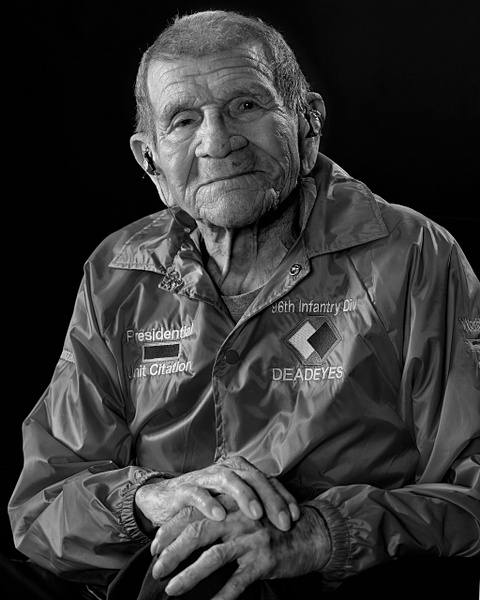
United States Army Private First Class World War II Joe Ray Gonzalez, Private First Class, was born on April 22, 1926. He was 96 years old when we first met. He said his lucky number is 96. He served in the U.S. Army during World War II as an infantryman with the well-known 96th Infantry Division, also known as The Deadeyes. Joe enlisted on September 18, 1944, and attended boot camp and initial training at Camp Roberts before joining the 96th. The Deadeyes served in campaigns along the Pacific front, including the Battle of Leyte on an island in the Philippines, the Ryukyu Islands, and later the landings and battles on the Island of Okinawa, where Joe joined the Deadeyes, who earned the Presidential Unit Citation for their efforts during that battle. Joe joined the 96th Infantry on April 12, 1945, the 12th day of the 82-day Battle of Okinawa, as one of more than 12,000 replacement troops supporting the battle. He remembered that his first miserable night on the island was spent in a foxhole. Only the companionship of his fellow Mexican service members helped him get through that tough first night. Joe earned his Combat Infantry Badge (CIB) on May 22, 1945, and was relieved of combat duties after the island was secured. Joe and the 96th Infantry Division faced intense fighting, especially at Kakazu Ridge, Nishibaru Ridge, and the Yaeju-Dake Escarpment. Under the XXIV Corps, the division was crucial in breaking the Shuri Line, and the island was declared secure on June 22, 1945. Joe did not have enough points to return home yet and was transferred to the Philippines with the 98th Infantry Division, where he served for the remainder of his enlistment. He returned to the United States in December 1946 for demobilization. Joe was one of fourteen children in his family; three of his brothers served in World War II. His brothers Jess and Art served in the U.S. Navy, and his brother John served as an MP in the Army’s Air Corps. Joe was honorably discharged and received the Asiatic-Pacific Campaign Medal, the Philippine Liberation Ribbon, the Good Conduct Medal, the Philippine Independence Ribbon, and the World War II Victory Medal.
mickey,strand,photograph,nik
Joe Gonzalez - WW2 Veterans - Mickey Strand - Veterans Series
United States Army Private First Class World War II Joe Ray Gonzalez, Private First Class, was born on April 22, 1926. He was 96 years old when we first met. He said his lucky number is 96. He served in the U.S. Army during World War II as an infantryman with the well-known 96th Infantry Division, also known as The Deadeyes. Joe enlisted on September 18, 1944, and attended boot camp and initial training at Camp Roberts before joining the 96th. The Deadeyes served in campaigns along the Pacific front, including the Battle of Leyte on an island in the Philippines, the Ryukyu Islands, and later the landings and battles on the Island of Okinawa, where Joe joined the Deadeyes, who earned the Presidential Unit Citation for their efforts during that battle. Joe joined the 96th Infantry on April 12, 1945, the 12th day of the 82-day Battle of Okinawa, as one of more than 12,000 replacement troops supporting the battle. He remembered that his first miserable night on the island was spent in a foxhole. Only the companionship of his fellow Mexican service members helped him get through that tough first night. Joe earned his Combat Infantry Badge (CIB) on May 22, 1945, and was relieved of combat duties after the island was secured. Joe and the 96th Infantry Division faced intense fighting, especially at Kakazu Ridge, Nishibaru Ridge, and the Yaeju-Dake Escarpment. Under the XXIV Corps, the division was crucial in breaking the Shuri Line, and the island was declared secure on June 22, 1945. Joe did not have enough points to return home yet and was transferred to the Philippines with the 98th Infantry Division, where he served for the remainder of his enlistment. He returned to the United States in December 1946 for demobilization. Joe was one of fourteen children in his family; three of his brothers served in World War II. His brothers Jess and Art served in the U.S. Navy, and his brother John served as an MP in the Army’s Air Corps. Joe was honorably discharged and received the Asiatic-Pacific Campaign Medal, the Philippine Liberation Ribbon, the Good Conduct Medal, the Philippine Independence Ribbon, and the World War II Victory Medal.